
The Great Simplification: Why Ad Tech Doesn’t Need More Technology - It Needs Better Commercial Execution
If you have worked in digital advertising for more than a decade, you have probably noticed something interesting.
Every year, our industry introduces another technology designed to make advertising simpler.
Programmatic buying promised efficiency. Header bidding promised better yield. Identity solutions responded to the decline of third-party cookies. Clean rooms offered a privacy-conscious way to collaborate around data. Retail media opened new sources of inventory and insight. Now AI is reshaping planning, creative production, optimisation and measurement.
Each of these developments has created genuine value. Yet the ecosystem has not become simpler. In many respects, it has become more fragmented.
Advertisers and publishers now navigate a dense landscape of DSPs, SSPs, data providers, identity graphs, clean rooms, measurement platforms, retail media networks and AI tools. For almost every problem, there is another platform promising to solve it.
The irony is hard to ignore: we have built an industry obsessed with reducing complexity by adding more complexity.
Technology Is No Longer the Biggest Challenge
For the past two decades, innovation has been the defining force in digital advertising. It gave the industry better automation, more precise targeting and increasingly sophisticated optimisation.
But I believe we have reached a different stage of maturity.
For many established advertisers, publishers and technology companies, the central challenge is no longer finding another tool. It is making the tools, data and teams they already have work together to produce measurable commercial value.
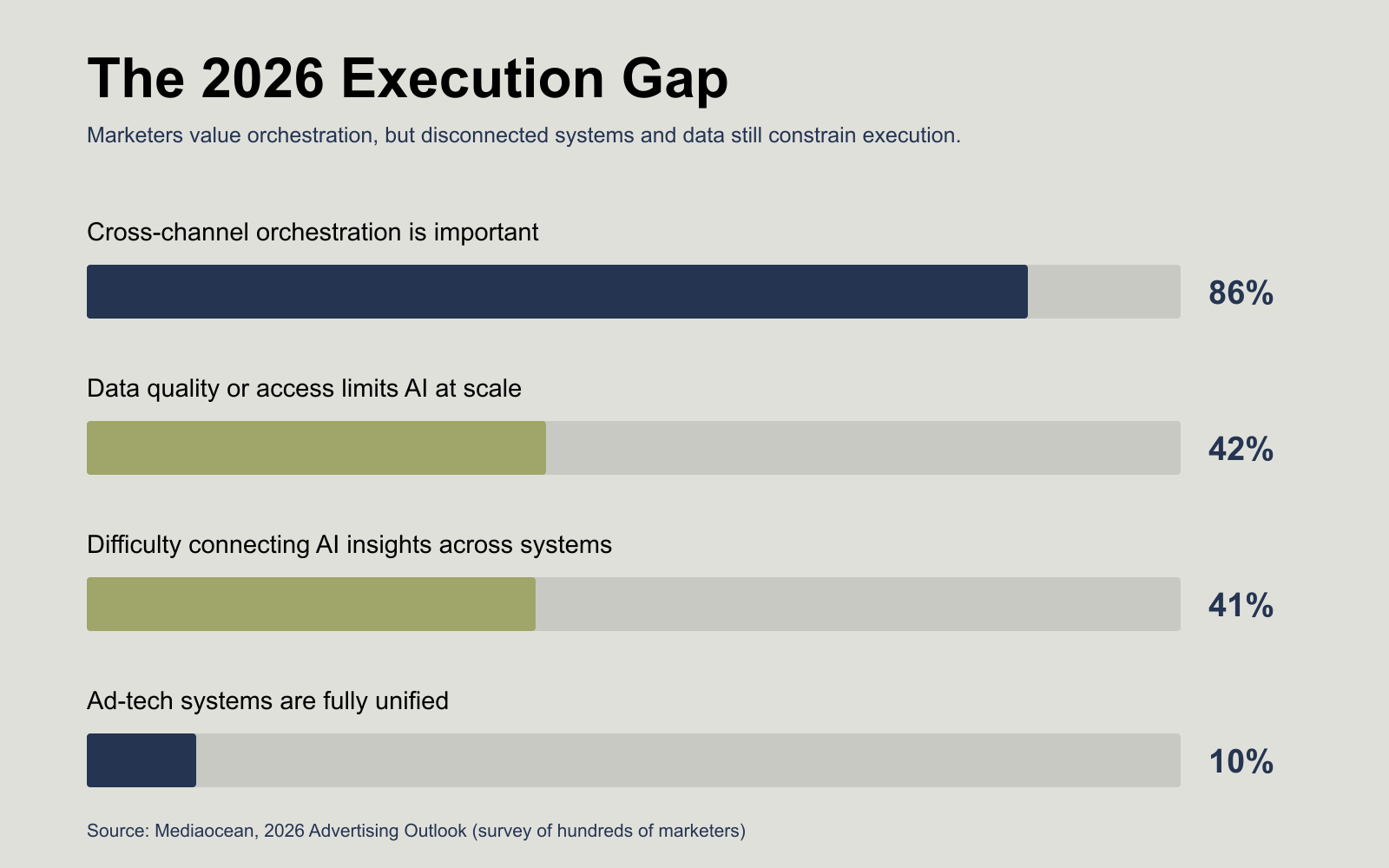
The evidence is striking. In Mediaocean’s 2026 Advertising Outlook, 86% of marketers said cross-channel orchestration was important, but only 10% reported having fully unified ad tech systems. The same research found that the largest barriers to scaling AI were data quality or access issues, cited by 42%, and difficulty connecting AI insights across systems, cited by 41%.[*1]
Those figures tell an important story.
The industry does not have an innovation shortage. It has an execution gap.
More Features Do Not Automatically Create More Value
Product innovation will always matter. Every platform needs to improve its capabilities, refine its algorithms and respond to changes in the market.
But more functionality does not automatically produce more value.
In conversations with agencies, publishers and technology companies, I hear a recurring theme. They are not asking for more dashboards. They want fewer disconnected systems. They are not simply asking whether a platform has AI. They want to know how its capabilities fit into their workflow and what measurable difference they will make.
The question is shifting from “What else can this platform do?” to “How easily can we adopt it, integrate it and generate value from it?”
That is a very different commercial conversation.
AI Is Raising the Bar, Not Removing It
AI has become the dominant theme across product announcements, industry events and investment strategies. Rightly so: it is already changing audience modelling, campaign planning, creative production, optimisation and measurement.
IAB’s 2026 Outlook Study found that five of the six leading areas of increased buyer focus were related to AI, with two-thirds of respondents focused specifically on agentic AI for ad buying and campaign execution.[*2] AI is moving rapidly from experimentation towards infrastructure.
But that shift has another consequence: AI itself becomes less distinctive.
If every SSP uses AI, every DSP offers AI-driven optimisation and every platform promises AI-powered insight, then the label stops being a meaningful differentiator. Buyers will judge the result instead: Does the product solve a specific problem? Does it fit their organisation? Can the team implement it? Can it deliver a credible commercial return?
Technology may open the conversation. Commercial execution determines whether that conversation becomes a long-term customer relationship.
Commercial Execution Is Becoming the Competitive Advantage
This is especially visible when technology companies expand internationally.
I have worked with ad tech businesses entering Asia Pacific from Europe, North America and Australia, and I have seen a consistent pattern. Most products are technically capable. Some outperform established alternatives in specific areas. Yet product quality alone rarely decides whether they gain traction.
Success depends on whether a company can answer a much simpler question:
Why should this customer change what they are already doing?
Answering it requires clear positioning, an understanding of the local market, trusted relationships, commercial discipline and patience. It also requires recognising that APAC is not one market. A proposition that resonates in Australia may need to be expressed differently in Singapore, Japan, India or Indonesia. Buying structures, publisher ecosystems, regulation and business culture all vary.
This is where global expansion plans often encounter reality. A company may have an excellent product and a compelling global story but still lack local proof, the right partnerships or a practical route into customer budgets.
The best product does not always win. Very often, the product that is easiest to understand, trust, adopt and buy does.
Simplicity Is a Strategic Choice
Simplification does not mean stripping away useful capability. Nor does it mean that the industry should stop innovating.
It means making deliberate choices about where technology creates value - and removing friction everywhere else.
For technology businesses, that starts with four questions:
Is our position clear? Can a prospective customer quickly understand the problem we solve, who we solve it for and why we are meaningfully different?
Is adoption straightforward? Have we reduced the technical, operational and organisational effort required to get started?
Does our commercial model fit the market? Are pricing, partnerships, sales motions and support aligned with how customers in that region actually buy?
Can we prove value? Do measurement and reporting connect product capability to the outcomes that matter to the customer?
None of these questions is as fashionable as launching a new AI feature. All four are more likely to determine whether innovation becomes revenue.
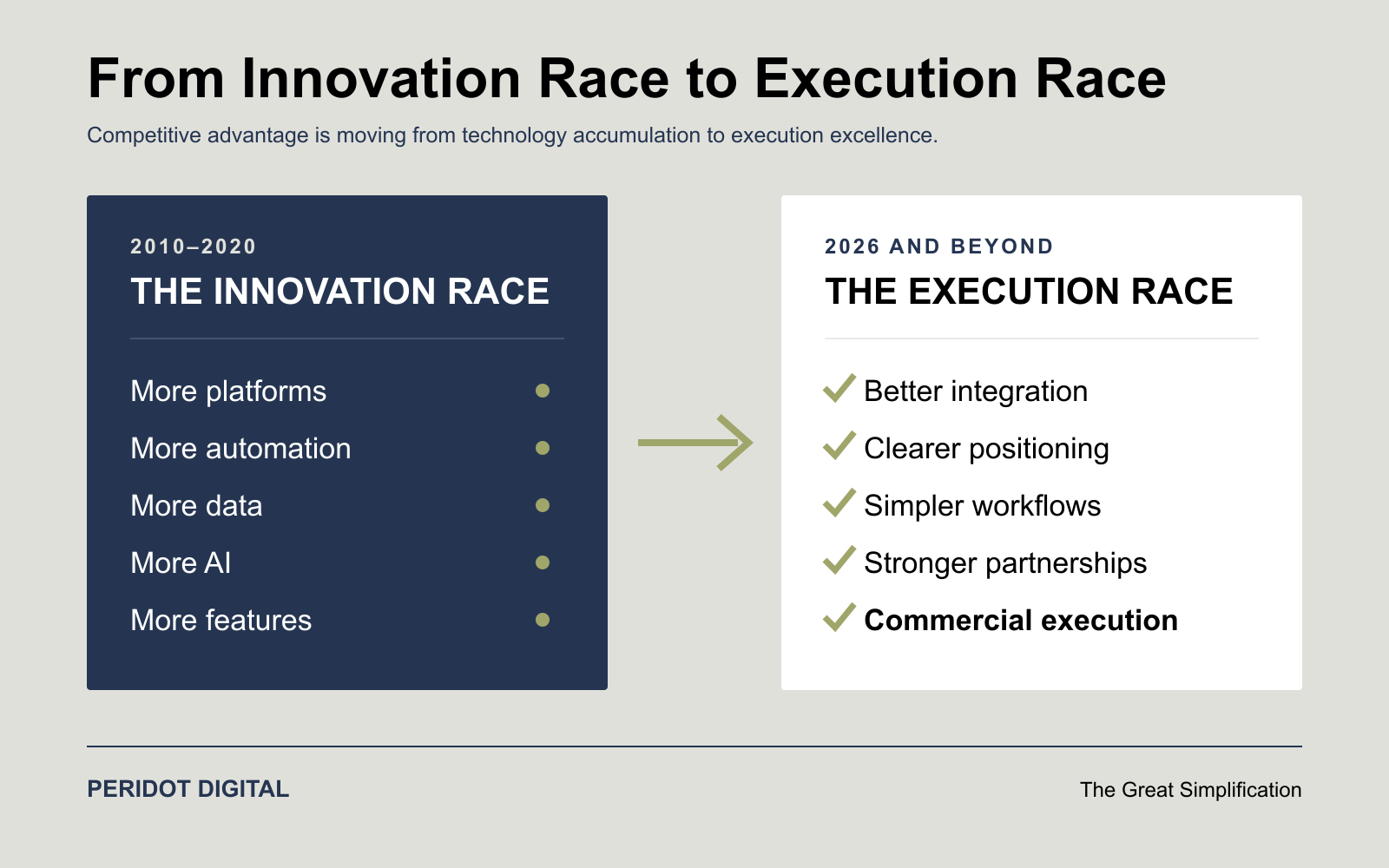
From Innovation Race to Execution Race
The next phase of ad tech will still be shaped by AI, automation and data science. Innovation is not slowing down.
What is changing is where sustainable advantage comes from.
As core capabilities become more widely available, feature lists will be easier to replicate. Clear positioning, market knowledge, trusted partnerships and consistent execution will remain much harder to copy.
The companies that succeed will be those that make sophisticated technology feel simple: simple to understand, simple to integrate, simple to buy and simple to connect to commercial outcomes.
The future of ad tech will not necessarily belong to the companies with the most technology.
It will belong to those that make technology work.
---
Peridot Digital helps advertising, media and technology businesses enter, expand and scale across Asia Pacific through go-to-market strategy, business development, strategic partnerships and local commercial support.
Sources
