
Why AI Won’t Replace Business Development in Ad Tech, But Will Change It Forever
If you attended the advertising industry’s major events this year or simply followed the headlines afterwards you could be forgiven for thinking that artificial intelligence has already taken over marketing.
Every major platform now talks about AI-powered campaign planning, AI-generated creative, automated media buying and intelligent optimisation. Google is embedding AI deeper into Search and YouTube. Meta has made AI central to its advertising roadmap. Agencies are redesigning workflows around AI-assisted planning and content creation, while almost every ad tech company now claims to have an AI-powered solution.
There is little doubt that AI will fundamentally reshape digital advertising. What is less certain, however, is what happens to the people behind the technology.
Over the past year, I’ve had numerous conversations with founders, commercial leaders and investors asking a similar question: “Will AI replace business development?”
My answer has consistently been the same. No. But it will fundamentally change how business development is done.
Technology Has Always Changed Advertising
Artificial intelligence is simply the latest in a long line of technologies that have transformed our industry. Programmatic buying automated media transactions. Real-time bidding replaced manual insertion orders. Machine learning improved bidding strategies. Audience modelling became increasingly sophisticated. Today, AI is accelerating creative production, campaign optimisation and predictive analytics.
Each of these innovations changed the way advertising operates. But, none of them removed the need for people who build businesses. If anything, they shifted the value of business development from administrative tasks towards strategic thinking and relationship building.
That shift is happening again.
Automation Solves Tasks. Relationships Solve Growth.
Artificial intelligence is remarkably good at analysing data, generating content and automating repetitive workflows. It can summarise meeting notes, identify potential prospects, write outreach emails, create presentation decks and even recommend campaign optimisations within seconds.
These capabilities will undoubtedly make commercial teams more productive. What AI cannot easily replicate is trust and relationship.
Successful business development has never simply been about finding prospects or sending emails. It is about understanding organisations, recognising opportunities that are not immediately visible, navigating internal politics and building relationships that develop over months or even years.
In many cases, partnerships are established because people trust the individual sitting across the table, not because a product demonstration scored highly in an evaluation.
That remains remarkably difficult to automate.

APAC Makes This Even More Relevant
This becomes even more apparent across Asia Pacific. Having worked across the region for more than a decade, one observation continues to hold true: business is still built on relationships.
While every market is becoming increasingly digital, the commercial culture often remains deeply personal.
In Japan, trust and consistency frequently matter more than speed. In Thailand and Indonesia, long-term relationships often open doors that cold outreach never will. Australia may move faster commercially, but decision-makers still want confidence that a partner understands their business rather than simply selling another technology platform.
This is one of the reasons global expansion strategies often struggle in APAC. Technology may be global. Commercial success rarely is.
Entering a new market requires understanding how decisions are made, who influences those decisions and why certain partnerships succeed while others fail. Those insights usually come from experience rather than algorithms.
Ironically, AI Makes Human Differentiation More Valuable
One of the more interesting consequences of AI is that it may actually make commercial differentiation harder. If every platform has access to AI-generated creative, automated bidding, predictive optimisation and intelligent reporting, those capabilities gradually become expected rather than exceptional.
The technology becomes the baseline. What remains difficult to copy are the things that sit around the technology:
A strong regional network.
Deep publisher relationships.
Credibility with agencies.
An understanding of local market dynamics.
The ability to recognise where a product genuinely fits—and perhaps more importantly, where it doesn’t.
Those are competitive advantages that cannot simply be downloaded or licensed. As AI lowers the barrier to building technology, it raises the importance of building meaningful commercial relationships.
The Role of Business Development Is Evolving
This doesn’t mean commercial teams should ignore AI. Quite the opposite.
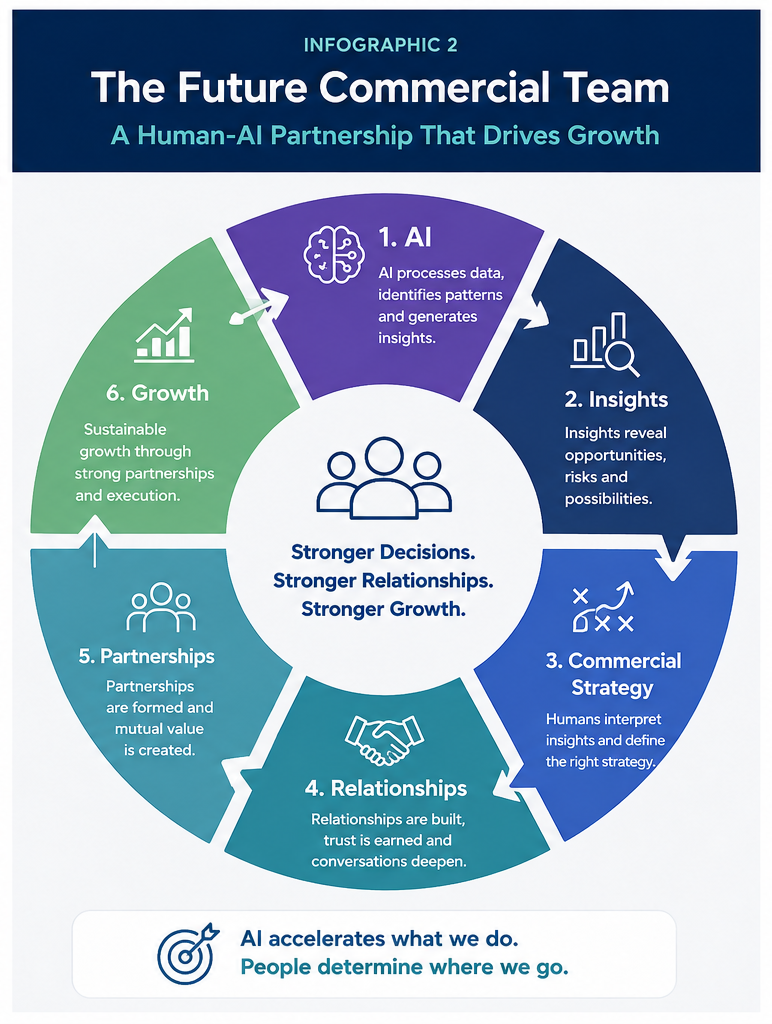
The most successful business development professionals will almost certainly be those who embrace AI as part of their daily workflow. Routine tasks such as research, meeting preparation, proposal drafting and CRM updates can increasingly be automated, allowing teams to spend more time where they create the greatest value: meeting customers, understanding markets, negotiating partnerships and identifying strategic opportunities.
The role itself becomes less transactional and more consultative. It is less about selling and more about solving problems. That evolution has been underway for years. AI is simply accelerating it.
Looking Ahead
Artificial intelligence will undoubtedly change how digital advertising is bought, sold and optimised. Campaigns will become smarter. Creative production will become faster. Audience discovery will become increasingly automated.
Yet despite these advances, successful businesses will still depend on people who understand markets, build trust and create long-term partnerships. In many ways, AI is making business development more valuable rather than less.
As technology becomes increasingly accessible, relationships, market expertise and commercial judgement become the true differentiators. That is particularly true in Asia Pacific, where every market has its own commercial culture, decision-making process and partnership ecosystem.
Technology may open the door, but People are still the ones who build the business!
References & Further Reading
