
Beyond Cookies: The Future of Audience Intelligence and Digital Targeting
For years, digital advertising was built around one fundamental capability: tracking users across the internet.
Third-party cookies became the infrastructure powering much of modern advertising, enabling audience targeting, retargeting, attribution and personalization at massive scale. Advertisers could follow user behavior across websites, build audience profiles and optimize campaigns based on browsing history and behavioral signals.
That model is now changing rapidly.
Privacy regulation, browser restrictions and shifting consumer expectations are fundamentally reshaping how advertisers think about data, targeting and audience intelligence. While Google’s timeline around cookie deprecation has evolved over the years, the broader industry direction is already clear: digital advertising is moving toward a more privacy-conscious and intelligence-driven future.
But despite the industry narrative around “the death of cookies,” this transition is not simply about losing a targeting mechanism. It is driving a much larger shift in how advertisers understand audiences altogether.
The Industry Is Moving Beyond Identity-Only Thinking
For much of the past decade, digital advertising focused heavily on identity-based targeting. Audience strategies were often built around:
browser tracking,
cross-site behavior,
demographic segmentation,
and retargeting models.
The assumption was simple: the more user-level data advertisers could collect, the more effective targeting would become.
Today, that assumption is being challenged. Consumers have become significantly more aware of how their data is collected and used online. Privacy regulation such as GDPR and CCPA, combined with browser-level restrictions introduced by Safari, Firefox and Chrome, have accelerated industry pressure toward more privacy-safe approaches.
At the same time, advertisers themselves are beginning to recognize the limitations of relying too heavily on traditional cookie-based tracking. In many cases, behavioral targeting became overly dependent on historical browsing patterns rather than real-time relevance or intent.
Context Is Becoming Intelligent Again
One of the biggest shifts happening in digital advertising is the resurgence of contextual intelligence. Historically, contextual advertising was relatively basic and largely focused on keyword matching and simple content categorization.
That is no longer the case. Modern AI-driven contextual intelligence can now evaluate:
semantic meaning,
content quality,
sentiment,
engagement context,
and behavioral relevance across enormous volumes of digital content in real time.
This allows advertisers to align campaigns with environments and moments that are contextually relevant without relying heavily on invasive user tracking. According to research referenced by Merkle, contextual targeting can increase consumer interest in advertising by approximately 32% compared to traditional demographic targeting approaches. This is an important shift. Rather than simply targeting “who” a person is, advertisers are increasingly focused on what users are actively consuming, researching, engaging with and showing intent around in the moment.
AI Is Changing Audience Discovery
Artificial intelligence is also dramatically expanding how audience intelligence works. Increasingly, AI-powered systems are able to identify patterns and relationships across:
content consumption,
search behavior,
contextual relevance,
commerce activity,
and engagement signals
that would be impossible to analyze manually at scale.
This is especially valuable for:
niche B2B targeting,
high-intent consumer audiences,
travel audiences,
and difficult-to-reach decision makers.
Rather than relying solely on static audience segments, advertisers can increasingly identify audiences dynamically based on evolving behavioral and contextual patterns. The result is often more adaptive and intent-driven targeting.
Privacy and Performance Are No Longer Opposites
For years, the advertising industry often framed privacy and advertising effectiveness as competing priorities. That perception is gradually changing. The future of audience intelligence is increasingly focused on balancing:
relevance, consent, contextual understanding, and first-party relationships.
In many cases, advertisers are discovering that privacy-first approaches can actually improve advertising quality by forcing greater focus on meaningful engagement, contextual alignment and higher-intent audiences.
According to Northbeam Contextual Advertising Insights, contextual targeting strategies are increasingly delivering stronger engagement, improved recall and more privacy-compliant audience activation.
Meanwhile, many marketers are shifting investment toward first-party data, consent-driven engagement and AI-powered audience modeling.
The Real Opportunity Is Smarter Audience Understanding
The long-term opportunity is not simply replacing cookies. It is building smarter and more adaptive audience intelligence systems altogether. The future of digital advertising will likely rely on combinations of:
contextual intelligence,
first-party relationships,
AI-driven audience modeling,
semantic analysis,
commerce signals,
and privacy-conscious behavioral understanding.
Audience intelligence is becoming less about tracking users everywhere and more about understanding intent, relevance and engagement within the right moments and environments. That is a fundamentally different mindset from traditional behavioral targeting.
The Shift Toward a Cookieless Advertising Ecosystem
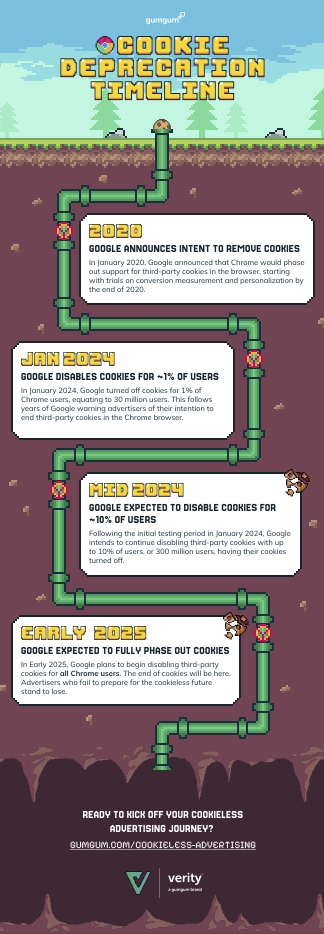
Source: GumGum Cookie Deprecation Timeline
Final Thoughts
The digital advertising industry is not simply entering a “cookieless future.” It is entering a more intelligent one.
As privacy expectations continue to evolve, advertisers are being forced to rethink how they identify and engage audiences online. The companies that adapt successfully will likely be those that move beyond dependency on historical tracking and focus instead on:
intent,
context,
engagement,
and smarter audience understanding.
Audience intelligence is becoming less about surveillance and more about relevance. And in the long run, that may ultimately create a healthier and more effective digital advertising ecosystem for advertisers, publishers and consumers alike.
